What is a digital marketing strategy?
A digital marketing strategy is a plan for how your business will grow visibility and capture your audience on digital channels like social media, the web, and AI platforms.
“Audience” is the operative word here. Many brands try to follow the latest marketing trends in their industry, or use the latest tools, but forget to prioritize their audience.
A digital marketing strategy that doesn’t center on your audience’s interests, pain points, and jobs-to-be-done won’t be effective.
You might still get site traffic, likes, or followers. But this will come from the wrong audience, so conversions will suffer.
A digital marketing strategy includes campaigns and tactics. Here’s how they’re different:
Digital marketing strategy | Digital marketing campaign | Digital marketing tactic |
Long-term plan that supports business priorities. | A targeted execution of a part of the strategy that supports a specific goal. It can span multiple channels. | An action within a marketing campaign on a single channel. |
Key components of a digital marketing strategy
Your audience is the foundational component of your digital marketing strategy. Without understanding your ideal customer profile (ICP), it’s harder to select the right marketing channels, define goals, and determine your budget.
Here’s how this and other components influence your digital marketing strategy:
- Goals: The main outcome that all the marketing campaigns and tactics ladder up to. For example, the goal could be to increase product adoption by startup marketers by 20%.
- Channel: The ways you will reach your core audience. Your ICP also influences channel selection. For startup marketers, LinkedIn would be an important channel.
- Budget: How much you’re willing to spend per channel. Also consider whether your investment in each channel will bring compounding long-term results.
- Metric: What you will measure to evaluate if the strategy is working. Consider both leading and lagging indicators.
- Audience: Who you’re targeting and what they care about. If your primary audience is startup marketers, then you need to understand their challenges and goals to target them. These could be a lack of budget, frequent pivots, wearing many hats at once, etc.
Let's say your company offers a software platform that simplifies reporting for marketing teams. Your goal is to increase product signups by 20% in the next quarter.
You could reach this audience on LinkedIn by promoting a webinar about automating weekly and monthly reporting. Then you'd track webinar sign-ups as a leading indicator and product signups as the lagging indicator.
Why is a digital marketing strategy important?
A digital marketing strategy is table stakes for both B2B and B2C businesses. Without it, you’re nearly invisible in digital channels that customers use to research and find products and services.
Here are a few of the biggest benefits of digital marketing strategy planning:
- Marketing team success and accountability: Marketers are most successful when they have a strategy to execute. It also keeps them accountable for achieving specific goals.
- Better customer understanding: A digital marketing strategy helps you better understand your business’s target audience. This can lead to successful marketing campaigns that align with customers’ pain points, needs, and preferences.
- Clear direction and focus: Developing a strategy requires audience research, competitive analysis, and goal mapping. You’ll glean important insights to guide your work and prevent random acts of marketing.
However, these benefits depend on marketers having access to customer data. HubSpot's 2026 research found that 12.4% of marketing leaders cite data sharing across teams as a barrier, and 19.5% struggle to adopt truly data-driven strategies.
If you don’t know who your customers are and what challenges they face, you can run into major issues like using messaging that doesn’t resonate with customers. Or poorly targeted marketing campaigns.
Search engine optimization (SEO)
SEO is a strategy that improves your website’s visibility in Google and other search engines. Websites with good SEO rank higher in search results for their target keywords, deliver a good user experience, and build topical authority in their industry.
The core pillars of SEO include:
- On-page SEO: Focuses on page and content structure
- Off-page SEO: Uses other authoritative websites to build your domain’s authority
- Technical SEO: Optimizes the website’s backend, including page speed and architecture
- Keyword research: Finds search terms you want to prioritize ranking for
SEO is a foundational digital marketing strategy because its return compounds over time. Improve your site's speed or structure and Google is more likely to rank you higher, which puts your brand in front of more potential customers who can convert.
SEO also underpins AI search: the same topical authority and content structure that earn rankings shape which sites AI platforms cite. So even as AI search grows, strong SEO does double duty, making you more competitive in traditional search and more visible in AI answers.
Agentic search optimization
Agentic search optimization (ASO) is the process of optimizing your digital presence for AI agents. In agentic search, AI agents answer user queries by autonomously browsing the internet, evaluating options, and then choosing the most relevant ones to present.
ASO is an umbrella term that covers:
- Generative engine optimization (GEO): How your brand appears in a model's training data and knowledge
- Answer engine optimization (AEO): How AI tools process and cite your content in real time
- LLM optimization (LLMO): Your presence and rankings within large language models
ASO has been hard for marketers because there's so much conflicting advice and so many one-off tactics that don't add up to a complete strategy.
That's why we built the Brand Orchestration Lifecycle as part of the Brand Visibility framework we unveiled at Adobe Summit. It's a four-stage system for approaching ASO methodically:
- Foundation: Create a clear brand narrative, define your entities, identify your audience, and find the topics you need to own
- Content: Publish multi-format content assets rooted in that foundation
- Distribution: Activate those assets across channels and surfaces
- Feedback: Use AI visibility signals like citations, sentiment, and rankings to refine your approach
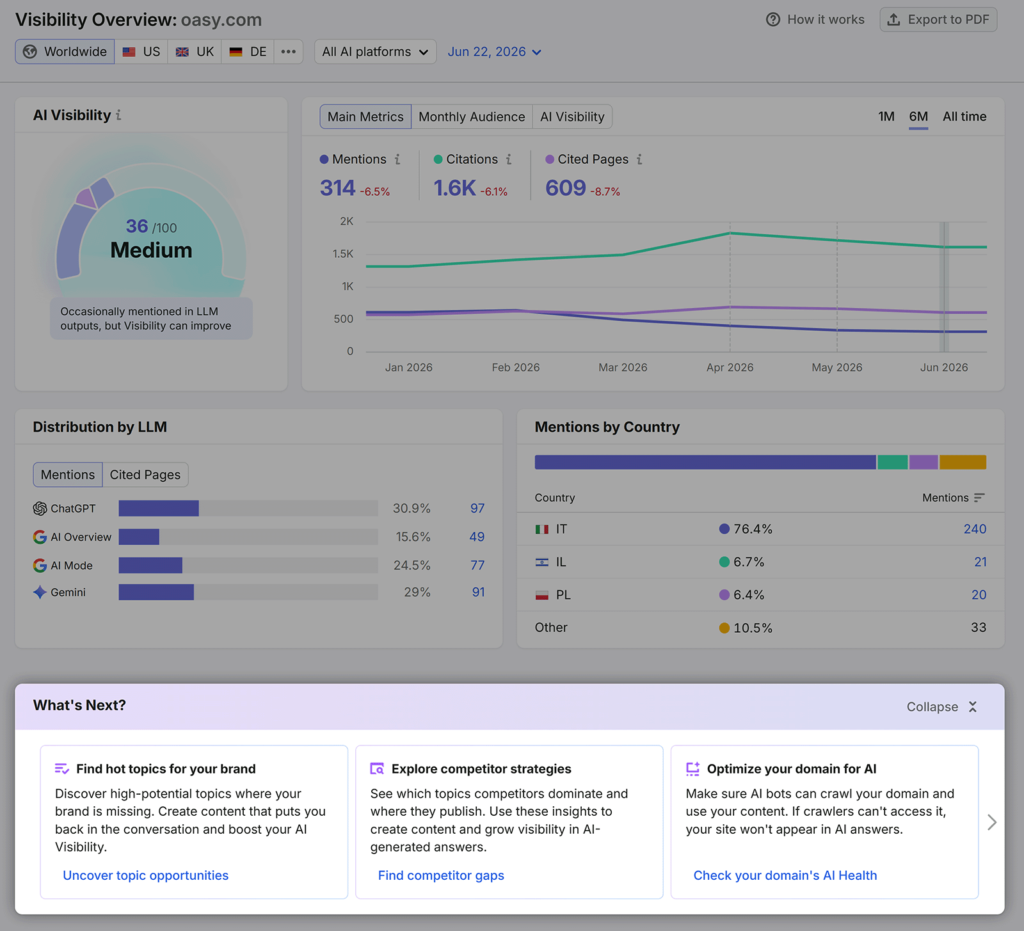
To see how you're showing up in AI search, Semrush's AI Visibility Toolkit benchmarks your brand's visibility across AI platforms and points you to where to focus next.
Enter your domain and click “Get started.”
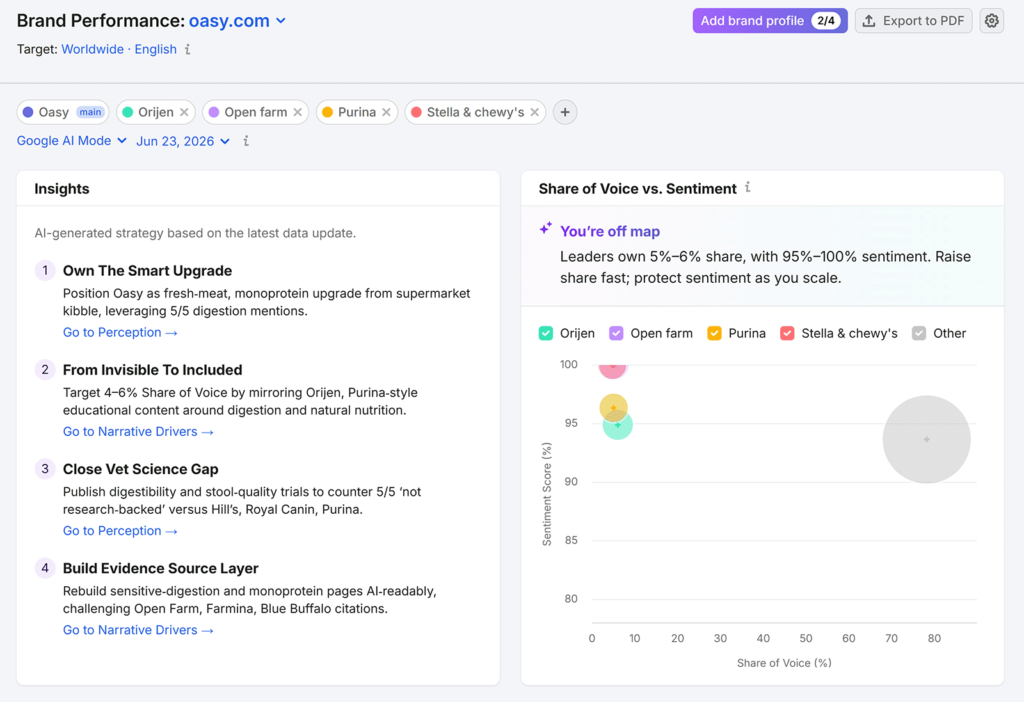
The “Brand Performance” dashboard provides a breakdown of your brand perception and share of voice compared to your rivals. You can use the AI-generated insights to get ideas for your ASO strategy.
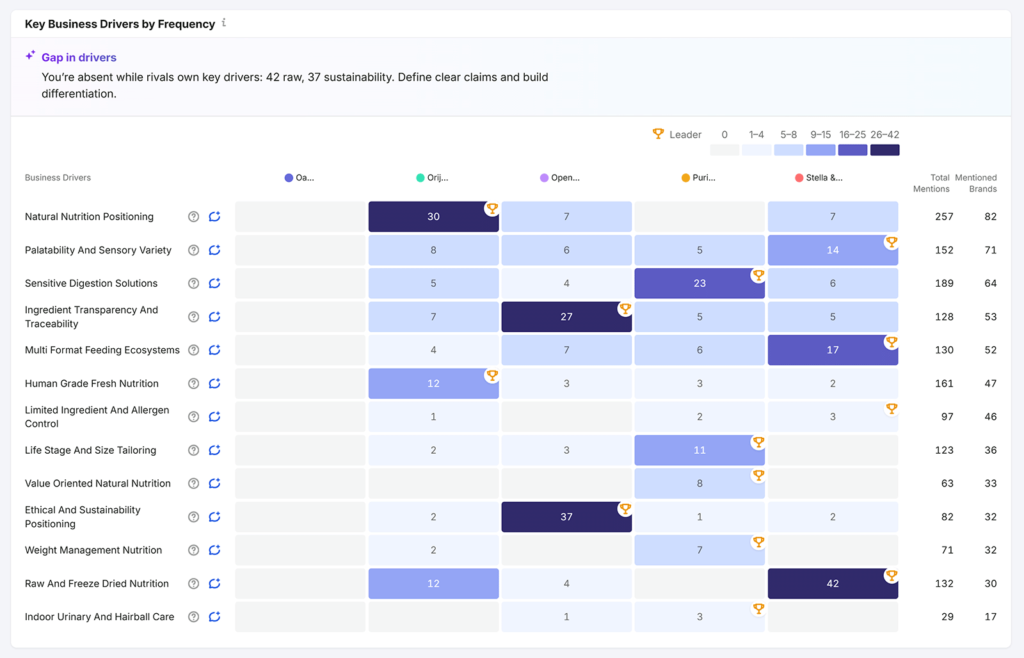
“Key Business Drivers” shows all the factors that support brand growth in your industry. And where each competitor is positioned in each driver.
Influencer marketing
Influencer marketing is the process of collaborating with social media creators who have a strong relationship with your audience.
Influencer partnerships are a different lever compared to your owned channels because you're getting access to someone else's following. And in exchange, you pay influencers a flat fee, send gifts, or set up affiliate deals.
The use of promo codes and affiliate links help you tie creator activity directly to sales, while engagement metrics allow you to measure overall campaign visibility.
Collaborations include one-off sponsored posts, ongoing creator partnerships, or user-generated content (UGC) you can repurpose across your own channels.
For example, software platform ServiceNow partnered with Instagram creator Corporate.bro to create a skit that promotes its new features.
How to build a digital marketing strategy
The seven steps below will help you create a digital marketing strategy:
Step 1: Define your brand
Defining your brand means getting clear on your brand identity and how it’s different from the competition. It’s the foundation of all marketing strategies.
One of the key factors when creating your brand identity is identifying the emotions you want to evoke in your audience.
For example, if you’re a B2B brand targeting enterprise clients, your brand should convey trust, security, and the ability to handle complexity.
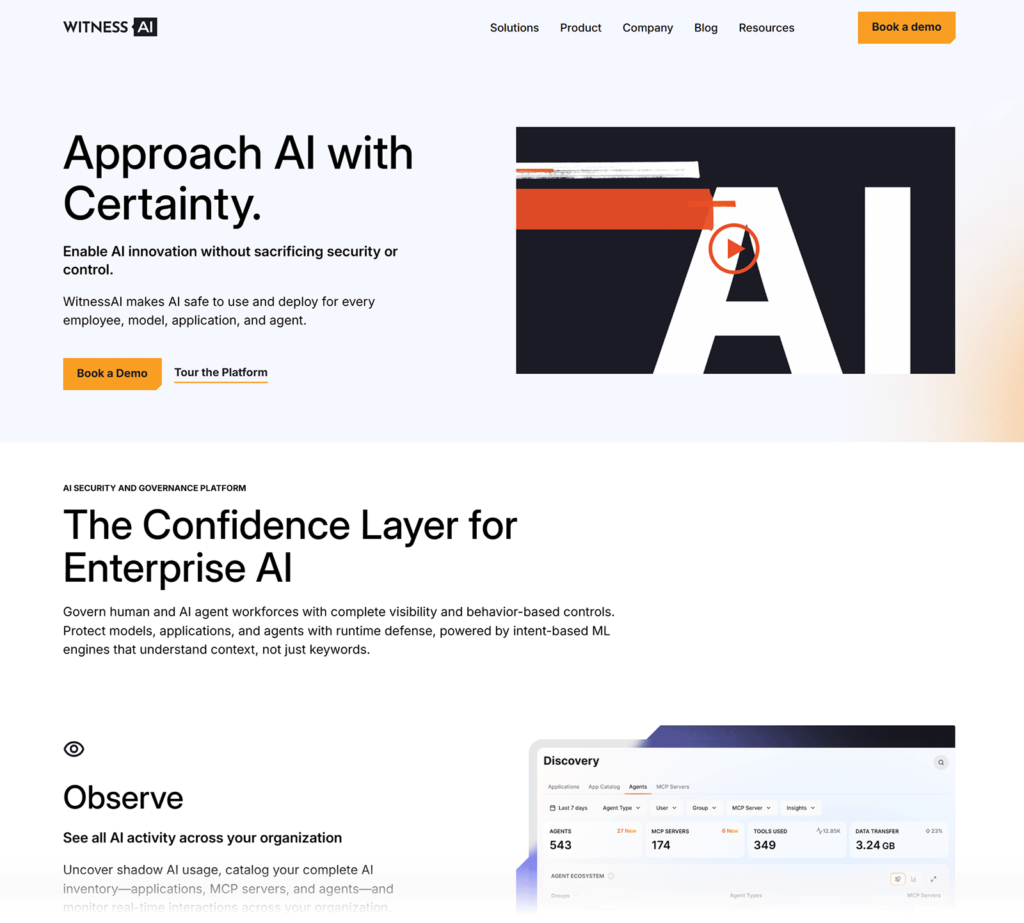
Cybersecurity platform WitnessAI does this with reassurance-driven messaging, positioning itself as a confidence layer that lets enterprises adopt AI without sacrificing security.